


Short answer: most mug shelves are only about a third full. A mug is roughly 4 inches tall. A kitchen shelf gap is usually 10 to 14 inches. That means there are 6 to 10 inches of empty air sitting above every row of mugs, doing nothing. You fit more mugs in by using that air, with a riser, hooks, or stackers, not by clearing out mugs you actually like.
Here is how to work out which one fits your kitchen, and when each one is the wrong choice.
Mugs are where most people start, because they are the obvious offender. But the same inches of wasted air sit above almost everything else in the cabinet, and the things that really fill it are not the big items — they are the awkward ones. Lids that will not sit still. Boxes that cannot be laid flat. The back third nobody has seen in a year. The last section of this piece deals with those.
Measure the gap first
Before you buy anything, measure one number: the vertical distance from the shelf your mugs sit on to the underside of the shelf above it. A tape measure, ten seconds.
That number decides everything that follows. A cabinet with an 8-inch gap and a cabinet with a 14-inch gap are two different problems, and most advice you will read online does not bother to ask which one you have.
While you are in there, measure your tallest mug too. The rule organizers use is to leave about two inches of clearance above the tallest item on a shelf, so you can lift things out without tilting them. Anything beyond those two inches is wasted space you can claim back.

Why the cabinet feels full when it isn't
Mugs are short and wide. Shelves are built for plates, bowls and cereal boxes, which are tall. So a mug shelf fills up sideways long before it fills up upward: you run out of shelf width with two-thirds of the height still empty.
This is why "just organize it better" never works on a mug cabinet. There is no arrangement of mugs on a flat shelf that uses the top half of the space. You need something that lifts a second row off the shelf.
The five ways to get more mugs in
1. Move the shelf itself
Free, and almost nobody tries it. Most cabinet shelves sit on adjustable pins. If your mug shelf has a 14-inch gap and the shelf below is crammed, drop the mug shelf down a notch and give the height to the shelf that needs it.
This does not create room for more mugs. It stops the mug shelf from stealing room from everything else. Do this first: it costs nothing and it may be all you need.
2. Add a shelf riser
A riser is a small platform on legs that creates a second level inside the shelf. Put short mugs underneath, taller ones on top.
Good when: your gap is 12 inches or more and your mugs are all a similar height.
Bad when: your mugs have handles that stick out at different angles, or the riser legs eat the shelf width you were trying to save. A riser that takes 2 inches of width to give you 5 inches of height is not always a win.
3. Hang hooks under the shelf
Screw-in or adhesive hooks under the shelf above, mugs hanging by the handle.
Good when: you have a handful of mugs with sturdy, uniform handles, and you do not mind drilling.
Bad when: you rent, your mugs have thin or short handles, or you have more than about six mugs. Hooks need spacing so the mugs do not knock together, and you run out of width fast. They also expose your mugs to dust, which matters more than people think.

4. Stack the mugs
A stacker sits on the rim of the bottom mug and creates a flat, locked platform for a second mug to sit on. The second row goes straight up into the empty air, using no extra shelf width at all.
Good when: your gap is roughly 9 inches or more, and you have a mixed collection: different shapes, different handles.
Bad when: your gap is under about 8 inches. Two mugs plus a stacker will not fit, and no product fixes a shelf that is genuinely too short. Move the shelf instead.
5. Take some mugs out of the cabinet
Not a trick, but it belongs on the list. If you own 30 mugs and use six, the other 24 do not need prime cabinet space at eye level. A box on the top shelf or in the garage is a legitimate answer, and it is free.
When stacking is the wrong answer
We make mug stackers, so take this in the spirit it is meant: they are not always the right call.
Skip them if your shelf gap is under 8 inches, because the arithmetic does not work. Skip them if you own four mugs; hooks are cheaper. Skip them if you grab the same mug fifteen times a day and will resent lifting one off another, though in practice the top mug lifts straight off.
They are the right call when the cabinet is full, the mugs are all different shapes, you cannot drill, and you do not want to give up a single inch of shelf width. That is the situation they were invented for.
How many mugs do you actually gain?
Doubling. That is the honest number, and it is simply what a second row means: a shelf that held six mugs holds twelve.
One ELYPRO 6-pack stacks up to 12 mugs. If you have two mug shelves and both are full, one pack handles one shelf.

Questions people ask
Is it safe to stack mugs on each other?
Not bare. Mug on mug slides, chips the rims and chips the glaze. What makes it safe is something between them that grips both and does not let the top one shift. That is the whole job of a stacker.
Will it work with my mugs?
The thing to check is shape, not size. ELYPRO stackers grip ceramic mugs, glass mugs, stemless wine glasses and tall mugs, and adjust to the mug's shape when you squeeze them. Very sharply tapered or irregular mugs are the ones to test first.
Will it damage my mugs?
The failure people expect is a hard edge against glaze. These lock the mug in place so there is no clinking and no shifting, which is the thing that actually chips mugs over time.
Can I use them in a rental?
Yes. No screws, no hooks, no adhesive, nothing touches the cabinet. They install by squeezing them onto the mug rim, with no tools at all.
Can they go in the dishwasher?
Yes. They are made from BPA-free, food-safe nylon built for daily kitchen use.

How they go on: the stacker sits on the rim of the bottom mug, the second mug goes on top upside-down, and you squeeze the two arms to grip whatever shape the mug is.
What is the best way to organize kitchen cabinets?
Recover height before you remove anything. Measure the gap between the top of what is on a shelf and the shelf above it, then use that gap — move the shelf down, stack what can be stacked, stand flat things on edge, and hang the awkward boxes underneath. Most kitchens find a whole shelf they already owned. Decluttering afterwards is a much easier decision, because you can finally see what is there.
Where do I put all the tumbler lids?
On edge. A lid lying flat spends its whole footprint on a quarter inch of height, and a loose stack slides apart every time you reach past it. Stood upright in a row, ten or twelve fit in a few inches and you can see every one.
How do I organize a deep cabinet where I cannot reach the back?
Keep a clear lane to the back and put the things you reach for least at the end of it, not buried behind the things you use daily. Depth is only a problem when the front becomes a wall. If it already has, that is the shelf to empty completely and reload — it is usually where the forgotten things are.
The stackers in this article
ELYPRO Mug Stackers are the original patented mug stacker, US Patent 9,199,765. ELYPRO's founder invented them after looking at a full cabinet and asking why mugs could not stack safely. There was no product category for this before.
A 6-pack is $24.99 and stacks up to 12 mugs. Black, blue or orange. Rated 4.77 out of 5 across 127 reviews.
See the Mug Stackers · All ELYPRO kitchen organizers
The rest of the cabinet is the same problem
The mug shelf is rarely the only shelf with wasted air in it. Two other things fill a kitchen cabinet, and each fails for its own reason.
Lids, because they will not sit still. Travel tumbler lids, water bottle tops, storage container lids. They are irregular, so they do not stack. They are light, so they shift every time you reach past them. And they are flat, so a lid lying down spends its whole footprint holding a quarter inch of height. Standing them on edge takes about a fifth of the space and lets you read the row at a glance.
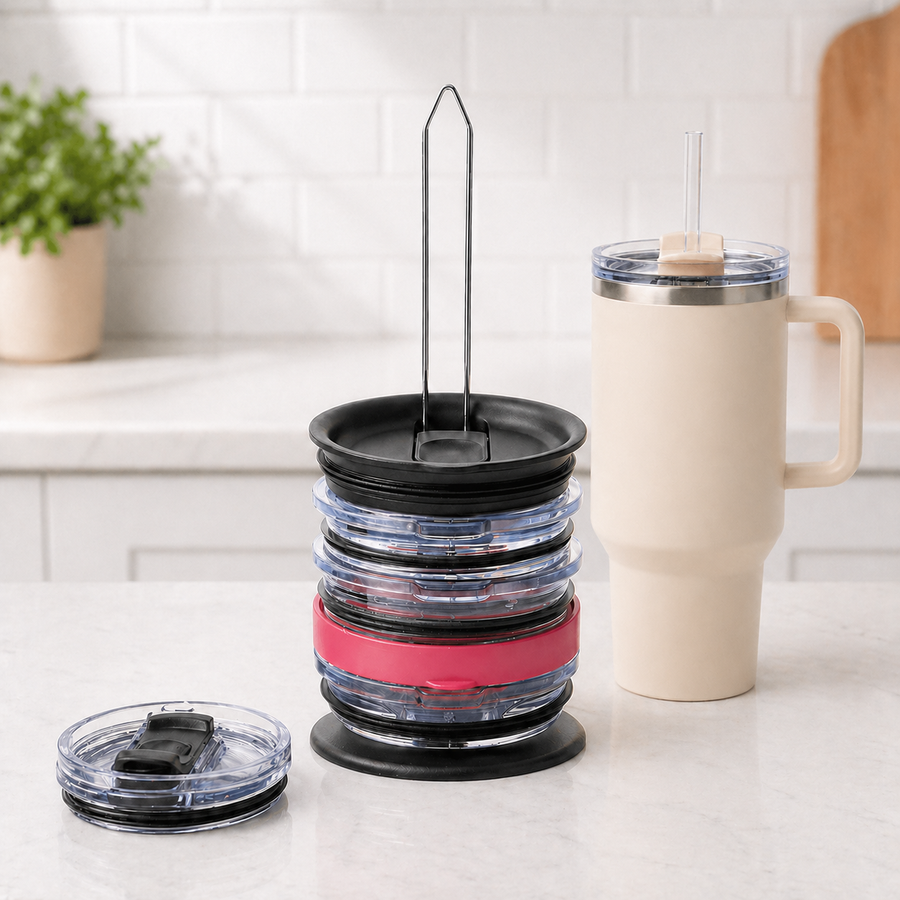
The Tumbler Lid Organizer, vertical stands them up on the counter or the shelf — up to ten lids in a three and a half inch footprint, seven and a half inches tall, no tools. It takes Stanley, Yeti, Hydro Flask and most travel mug and water bottle lids.
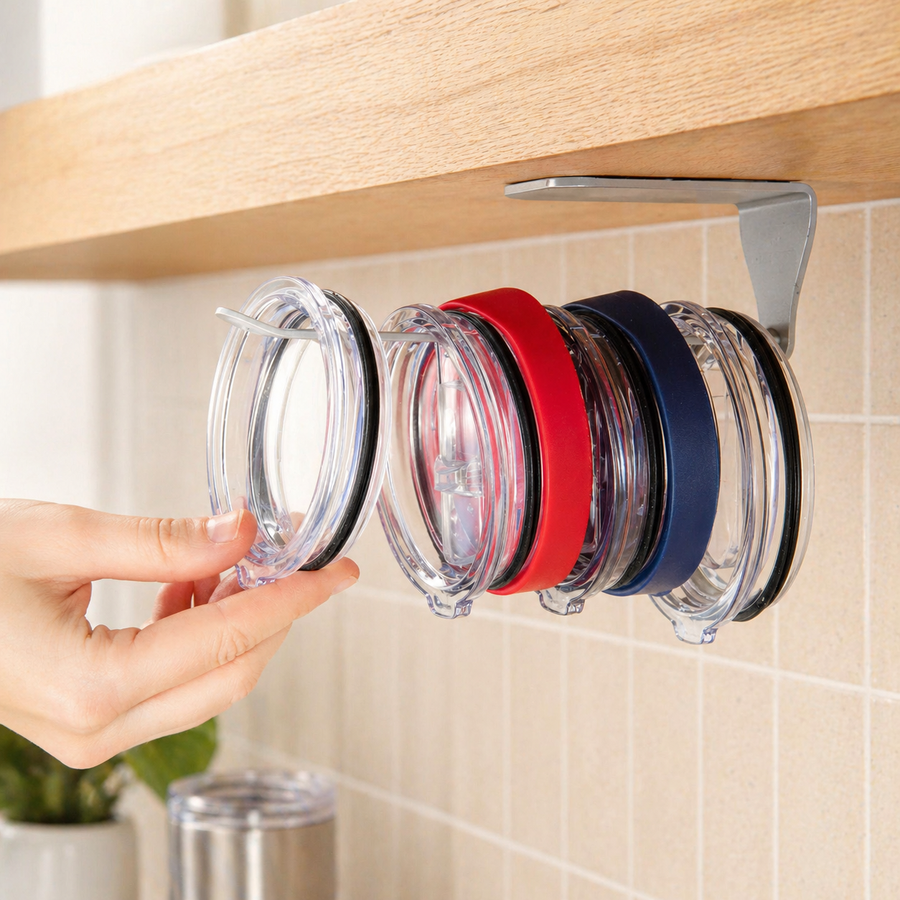
The under-cabinet version does the same job from the underside of the shelf, using the gap rather than the surface, with adhesive instead of drilling. If shelf space is your constraint and headroom is not, that is the one.
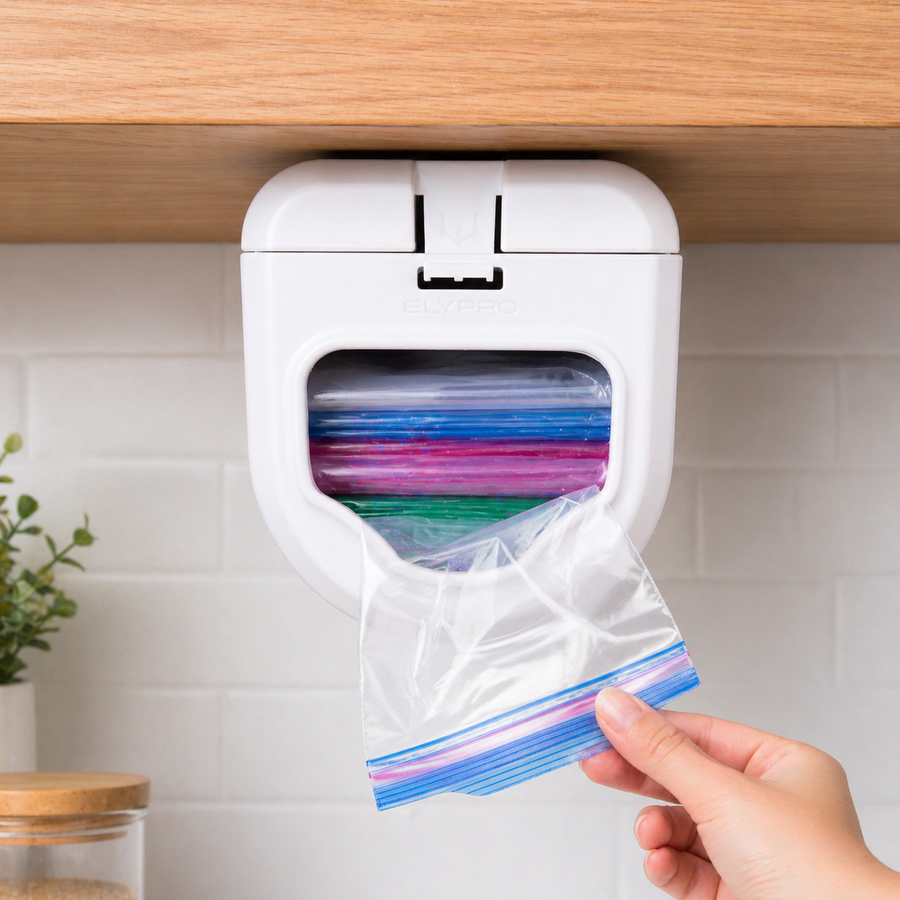
Boxes and bags, because they cannot be laid flat. A box of sandwich bags is mostly air and awkward proportions, and three or four of them will take more room than the mugs beside them. These are the things to move off the shelf entirely — under it, or onto the inside of the door. The Ziplock Bag Dispenser mounts under a cabinet and feeds quart, sandwich and snack bags out one at a time, one-handed.
And the back third. That is where things go to be forgotten, and it is the one part decluttering genuinely fixes. It is also why decluttering comes last rather than first: once you can see the back, you can decide honestly about what is in it.


